
Guido Sartorelli. Deconstructing the cliché
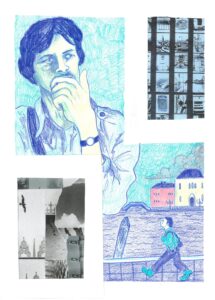
[Illustration: Annachiara Mezzanini]
Anyone who gets to know Venice soon realizes that never seems to come a time when you stop being surprised: by the way the sun creeps through the streets, by the shifting colors of the sky reflected on the lagoon’s water, by the fog that envelops everything in a ghostly veil, by the wind that sweeps through the streets, making the laundry flutter and leaving a caressing sensation on the skin. Living in Venice means knowing that, inevitably, every day these small moments unfold slightly differently from the day before, and for this very reason, they always seem worthy of being captured.
You find yourself taking yet another photograph, while your phone’s gallery fills up relentlessly, until it overflows with images: all similar, yet all different. Snapshots of the city arranged side by side, as if keeping each other company, giving rise to random photographic juxtapositions, to visual grids composed as much of subjects now worn out by the gaze of tourists as of others that appear new to us, removed from the canonized image of the lagoon and part of an intimate vision of this fragment of the world.
As we look back at this personal and fortuitous photographic assemblage on our phones—the result of a spontaneous act of daily accumulation—we recall from memory some works by the Venetian artist Guido Sartorelli (1936–2016). For him, the city of Venice has always played a central role, not only because it served as the backdrop to his career, but also because it was the subject of his artistic and social research through which, thanks to collage, he transformed the already-seen into new possibilities of vision.
Our encounter with Sartorelli happened somewhat by chance when, in 2023, we found ourselves reflecting on his artistic practice. It was not a project we’d been planning for a long time; it all began within a university workshop, where his work gradually emerged through different perspectives, amid papers, notes, and archival materials preserved at the Fondazione Bevilacqua La Masa in Venice, which at the time were awaiting cataloging. In doing so, we discovered the figure of Sartorelli, who had slipped into a silent shadow, and came to appreciate the depth of his gaze and his research, which has always been intimately linked to his city, not only in its urban design but also in its social fabric.
The origins of this body of work can be traced back to 1968, the year in which the artist became aware of the need to rethink the relationship between art and society, making this the focus of his artistic research, a “practice of a philosophical nature” that enables people to see beyond the surface and anticipate social issues and challenges. Sartorelli thus began to reflect on the urban context, where the city “is often a stage set and more” (Madesani 2007). Since the 1970s, he has devoted a significant portion of his work to the forms of the city, fascinated above all by their ability to bear the marks “of our critical culture, of doubt and dialectic, but also of our behaviors and our civil and religious powers, whether democratic, oppressive, or transgressive” (Sartorelli 2003).
Sartorelli’s focus on and analysis of cities and urban symbols have taken shape through various media and techniques, among which video, videotape, and photography have been his preferred choices, considered best suited to representing reality, contemporary society, and urban forms. Since the 1970s, his works have increasingly featured collages of urban vistas, as if to reimagine, with inverted imagery, postcards and puzzles depicting cityscapes, the most ubiquitous souvenirs of the touristification era.
With an approach that is at once analytical and synthetic, rational and symbolic, Sartorelli portrays, deconstructs, and reconstructs urban elements to create collages and grids, sometimes elaborate and fixed in form, sometimes freely reconfigurable by the viewer. Through the project La mia Europa (2003), perhaps one of the most articulate and successful outcomes of his research on the city, Sartorelli displays, via the combinatory practice of collage, photographs taken in various European cities. The work gives space to countless and minute urban fragments, to be reassembled into units that yield different syntheses of the urban portrait: a way, this, to “draw upon the usual specificity of the art’s language, which serves no purpose other than to make us question things” (Sartorelli 2003).
As mentioned, the artist focused a significant part of his work on his native city, to which he dedicated three exhibitions in particular: Il segno urbano. Indagine nel centro storico di Venezia. Analisi e confronti (Venice, Galleria dell’Opera Bevilacqua La Masa, 5–21 March 1977); Semiopolis. Venezia come luogo dei segni (Venice, Galleria dell’Opera Bevilacqua La Masa, 20 October–11 November 1984); and Metamorphoses (Martigues, Chapelle de l’Annonciade, 1987). The first of these, divided into nine sessions, aimed to stimulate reflection on the complex relationship between the city and contemporary life, involving community members to construct a shared and critical reading of urban space. The idea of taking stock of collective problems and addressing them without moments of dialogue was considered an act of sheer short-sightedness—today, the spirit that animates projects like ardór remains the same.
In Il segno urbano, Sartorelli examined “another reality of the city, beyond its tradition, using the new mental tools of the post-conceptual critical artist,” investigating “the designed forms of street furniture and all the other spontaneous micro-forms present on the scene as traces of social life” (Sartorelli 1998, 29). The exhibition emerged not only as the result of discussions and debate, but also of prior readings and reflections. Among the texts in Sartorelli’s library, we find, in fact, an issue of the journal “Dibattito urbanistico”, focused specifically on Venice, where we read:
Even today the “lament” over Venice refers to a picture-postcard, mythical, idealized image of the city, typical of famous Venetian views. With this idealized vision, Venice becomes an object—beautiful, of course—that we feel compelled to preserve; yet we miss the opportunity to approach it as a subject. Venice as a social entity—the classical one that shaped the physical Venice we jealously preserve today, even angrily, one might say—was something quite different […]. Venice was, is, and should remain a living, real body (Cedolini 1970).
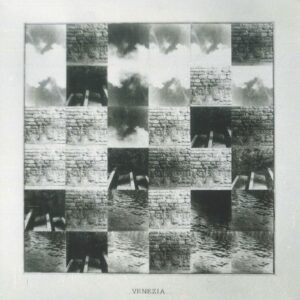
[Image: Guido Sartorelli, Venezia, 1990, Venice, Bevilacqua La Masa Foundation Archive, Sartorelli Collection, Venezia contro la luna – Uccidiamo il luogo comune.]
The artist’s eye therefore focused on Venice as a subject: on the small folds of everyday life, on the minute forms that interact and influence one another alongside the larger ones. His aim was to record and collect the traces of imperceptible changes, the anonymous, slow transformations produced by the incessant clash between matter, humanity, and atmospheric forces. The collected signs were displayed with the aim of presenting the city in a way that might free it from the “cliché that lowers the threshold of our consciousness” (Sartorelli 2004, 45). This inclination led him to reject the flattening of Venice to a passive object, narrated and represented from a single perspective and confined within a single, rigid grid, neither decomposable nor, much less, recomposable:
Generally speaking, we photograph what has already been photographed and what we are expected to photograph. And if things that have not been photographed appear before us, we do not look at them; we do not want to see them. We neither talk about them nor pass them on.. All of this fuels the horrible disease of the cliché. Venice is a perfect example of this.
The quote comes from the unfinished project Venezia contro la luna. Uccidiamo il luogo comune (Venice Against the Moon: Let’s Kill the Cliché), a compendium of reflections developed over previous years and an explicit reference to Marinetti’s Futurist manifesto Uccidiamo il chiaro di luna (Let’s Kill the Moonlight), in which he declared “When we shouted, ‘Let’s kill the moonlight!’ we were thinking of you, old Venice, soaked in romanticism” (Marinetti 2000, 10).
Sartorelli’s critical approach to the lagoon stems from a layering of bibliographical influences, but above all from a direct encounter with the idealized representations of Venice, with which, as a Venetian himself, he has always engaged, and clashed. While Marinetti advocated for the unrestricted urbanization of Venice, with asphalt stretching as far as the eye can see, Sartorelli chose an alternative path. “Killing the cliché” thus means stimulating the observer’s critical gaze, restoring complexity to Venice and to the images of it that crowd the collective imagination—and, we might add today, saturate the screens of our phones.
In this process, art bears a specific ethical responsibility: to guide the public away from clichés, to question their own gaze, and to prompt reflection on where the eye (whether human or photographic) rests. Only in this way can commonplaces be transformed into spaces of awareness and, ultimately, into places of community.
References
Cedolini M. (1970), Per una demistificazione del problema veneziano, in “Dibattito urbanistico”, nn. 30-31.
Madesani A. (2007), Banchi di nuvole sparse. Note su alcuni recenti lavori di Guido Sartorelli, in Sartorelli G., Metropolis, exhibition catalogue, edited by Madesani A., Galleria Michela Rizzo, Venezia, January 12 – February 14 2007.
Marinetti F. T. (2000), Uccidiamo il Chiaro di Luna!, in De Maria L. (edited by), Filippo Tommaso Marinetti e il futurismo, Mondadori, Milano.
Sartorelli G. (1998), Punto di vista. Cronache e riflessioni intorno a un’esperienza artistica, Supernova, Venezia.
Sartorelli G. (2003), La mia Europa, Edizioni del Cavallino, Venezia, Stamperia DBS, Seren del Grappa, Belluno.
Sartorelli G. (2004), Il libero fluire delle cose nella città notturna (1987), in Sartorelli G., Per pretesto e per amore. Immagini e parole intorno all’arte e alla città, 1968-2004, Supernova, Venezia.
Costanza Mazzuchelli + Elena Barison
Costanza Mazzucchelli is currently specializing in Historic and Artistic Heritage, after earning a degree in Contemporary Art History with a thesis focused on the socio-political practice of Piero Gilardi.
She collaborates with public institutions, private organizations, and magazines, with a particular interest in site-specific artistic and cultural projects and contemporary art archives.
Elena Barison is a specialist in historical and artistic heritage and conducts research on contemporary art, with a particular focus on the verbal-visual experiments of the neo-avant-garde and gender issues.
She collaborates with public institutions, such as the Querini Stampalia Foundation in Venice, and private institutions, including the Tomaso Binga Archive, as well as with magazines and independent organisations.