Fatalità with Lavinia Fagiuoli
“I was just thinking about you, and here you are – fatalità.”
“I went to pay for parking, and, fatalità, I happened to have five-euros in my pocket.”
“I was looking for something, and, fatalità, I found it.”
In Venetian, ‘fatalità’ often has a neutral, if not downright positive, connotation. It’s a word that fascinates me because it sheds light on a form of pragmatic, everyday fatalism – one shaped more by lucky coincidences than by inescapable destiny.
In Venice, it’s used all the time, almost like a little phrase to acknowledge life’s unpredictable alignments. Sure, it’s still fatalism, but lightened by irony and experience: less dramatic, more down-to-earth. Perhaps, quite simply, a little better than usual.
Fatalità I met Lavinia through a dear friend, Elena. Elena is Venetian; she works in the art and publishing worlds and is surrounded by wonderful friends. In the deepest sense of the word: Elena truly has beautiful friendships, because she is the first to be a true friend. She’s a girl full of common sense, generous, and a good listener, and she knows everything there is to know about Venice’s social scene – which, as you can imagine or may already know, is actually quite small. And so, in May 2024, through a series of connections and events, Elena invited Lavinia to a drawing workshop – which I also attended – led by the Sudanese activist Khalid Albaih. So, fatalità, I met Lavinia and discovered that she’s an illustrator, that she’s just moved from Milan but often goes back there, and that she’s the owner of Oriana, a dachshund who stays in her arms all the time, has a soft spot for men with a barchino (a little boat) (I’m still talking about Oriana), and looks great in photos.
Lavinia Fagiuoli is an illustrator who is gaining increasing recognition across Italy. Her graceful, watercolor-like style can be found on many surfaces, including paper, ceramics, and in numerous newspapers such as “L’Espresso” and “Il Corriere della Sera”; she has also worked for publishers like Iperborea, Mondadori, Rizzoli, and Sellerio, as well as on cultural projects such as Isola Edipo in Venice. What has always intrigued me about Lavinia is that she trained as a lawyer (and still practices law) but has been drawing her whole life. Now she’s a full-time artist. In 2020, drawing became her new career. So I had a chat with Lavinia, along with Oriana, and of course Elena, who prepared breakfast for us and hosted us on a terrace covered with wisteria branches and blossoms (it was May).
Alice Ongaro Sartori (AOS): Lavinia, how did you end up in Venice?
Lavinia Fagiuoli (LF): It all started with a residency at the Garance & Marion gallery. We were both just starting out – they with the gallery, and I with my career as an artist. In 2023, they wanted to start inviting illustrators to spend some time in Venice, at Studio Lama Farfalla in San Piero di Castello. And that’s where I went. At the time, I wanted to leave Milan. I had Rome and Marseille in mind, but then – as you say, fatalità – they invited me to do the residency. And here we are. I remember that when I was little, I’d seen the Peggy Guggenheim Collection; I’d seen photos of Peggy, surrounded by her dogs and her artworks at home. I thought she was the artist, that she’d created all those works herself. So I told my mom: I want little dogs, I want to paint, I want to be in Venice. When you’re a child, you don’t just wish for things, you are that wish.
I realized that I’ve found my place, my sense of belonging here. The things people criticize about the city – like the fact that it’s small and there aren’t many people – I see as an advantage. Especially when you’re new here, it’s actually ideal; you get to know everyone in no time. The city is welcoming. For me, crossing the bridge when I leave Venice gives me a knot in my stomach, but when I return to the lagoon, I finally feel at home. The exhibition was called Lettere d’amore, and I created all the works during my residency. The theme was female friendship, which is very important to me.
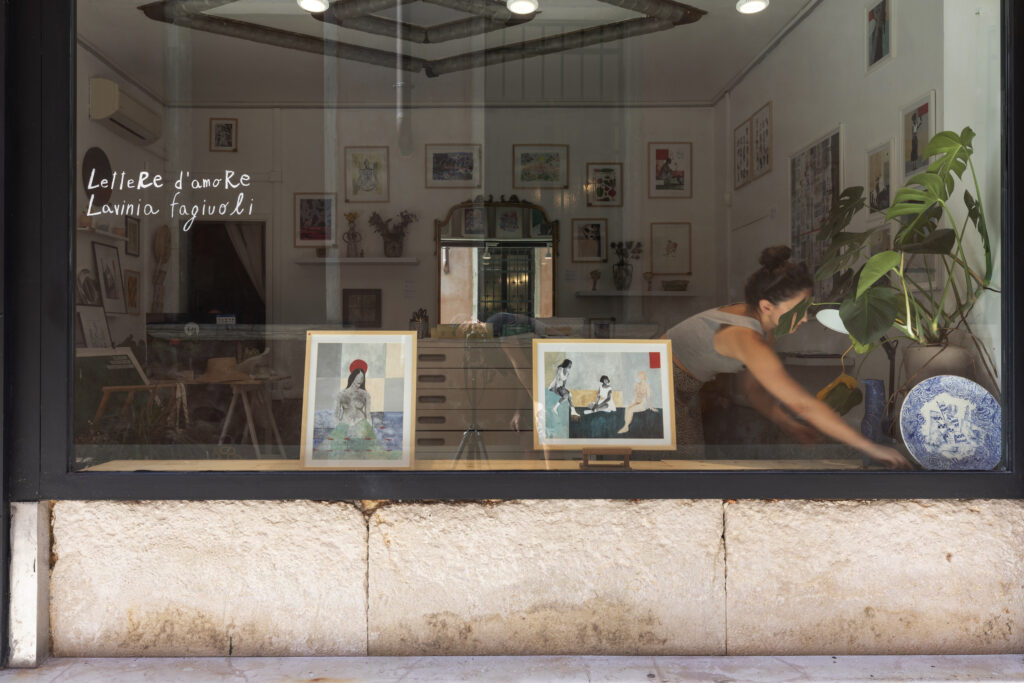
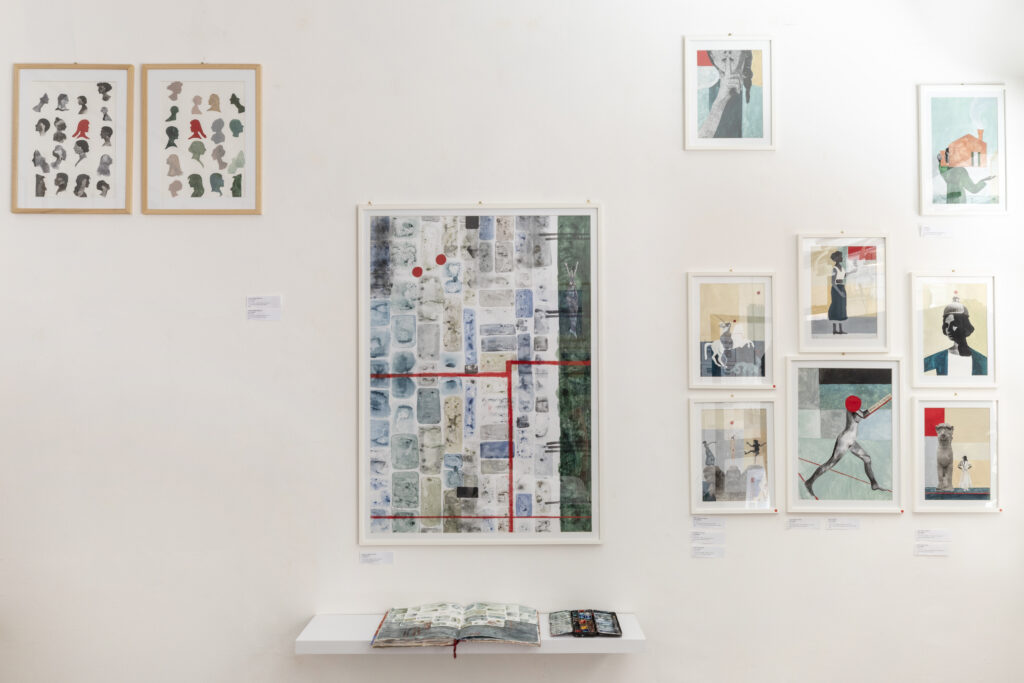
[Lettere d’amore, a solo exhibition by Lavinia Fagiuoli, 27 June – 27 September 2023, Venice, Garance & Marion. Photo by Jacopo Trabuio.]
AOS: The theme of friendship is beautiful. The strongest relationships, the ones you identify with, are the ones free from certain emotions. Some people have friendships that are often complex to manage, where there’s jealousy; I, on the other hand, have female friends with whom I feel a special, direct connection.
Do you have sisters? Or brothers?
LF: I have two brothers. But with my female friends, I have a direct relationship, uninhibited and, above all, free of jealousy. And that’s why I created this exhibition on this theme. This piece, for example, is about the fatalità of friendship – that is, why does a person become your friend? Often, you don’t know exactly. For me, friendship is even more a matter of fatalità than love. You don’t know why someone makes you laugh, while someone else doesn’t; why you feel welcomed and drawn to one person, but not to another. This, on the other hand, is a piece the gallery owners requested. It was in one of my sketchbooks, and then we reproduced it on a large scale. I always start with a sketch in my notebook. That’s my method. It’s a piece about masegni (Venetian paving stone), with a hidden mermaid.
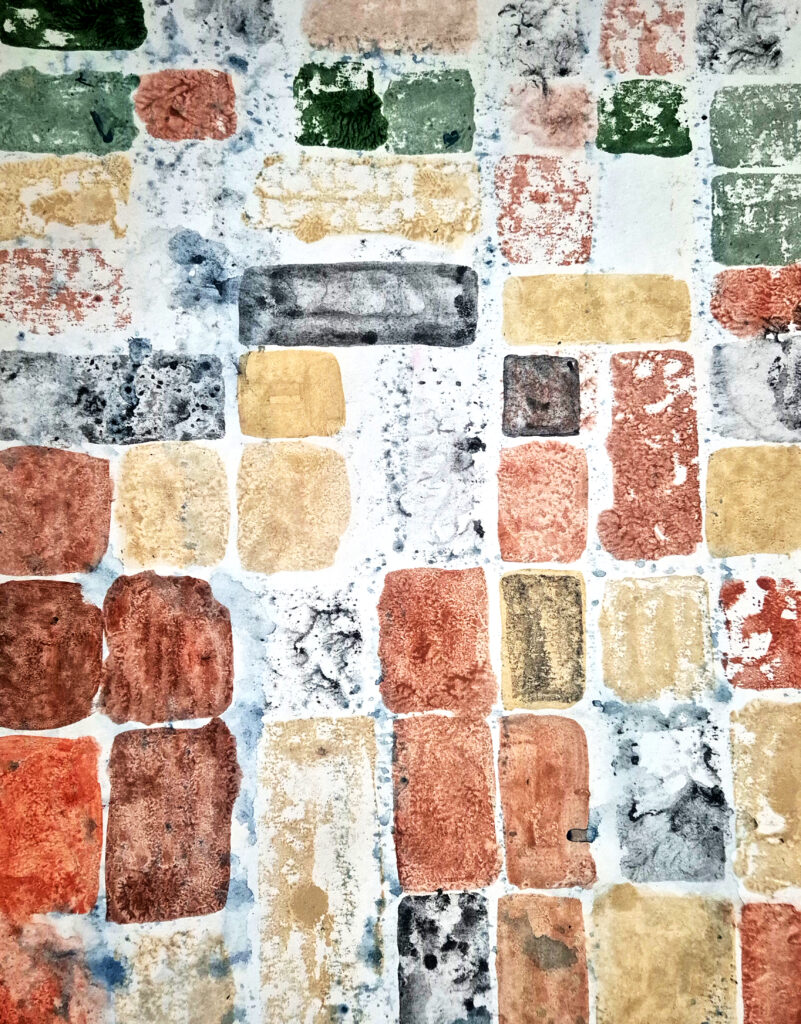
[Lavinia Fagiuoli, Masegni, monotype and watercolour on paper, 30×40 cm, Venice, 2023.]
AOS: Are these all masegni seen from above? Would you like some coffee?
LF: Yes, and then there are all the bricole (distinctive nautical structure used in the Venice Lagoon), and the mermaid seen from above.
AOS: So you start with a sketchbook, paper, and watercolors. And then?
LF: And then there’s almost always a collage of what I create. I always do everything by hand, and then, sometimes, I finish it digitally. The works in my solo exhibition at the Garance & Marion gallery are all hand-painted. There’s also this piece featuring a female version of Saint George and the Dragon in St. Peter’s, a female Saint George (dedicated to a friend of mine), the fish of Rialto, St. Peter’s, the Lion of the Arsenale, and here are Oriana and I. This was sort of the beginning; then I decided to settle down.
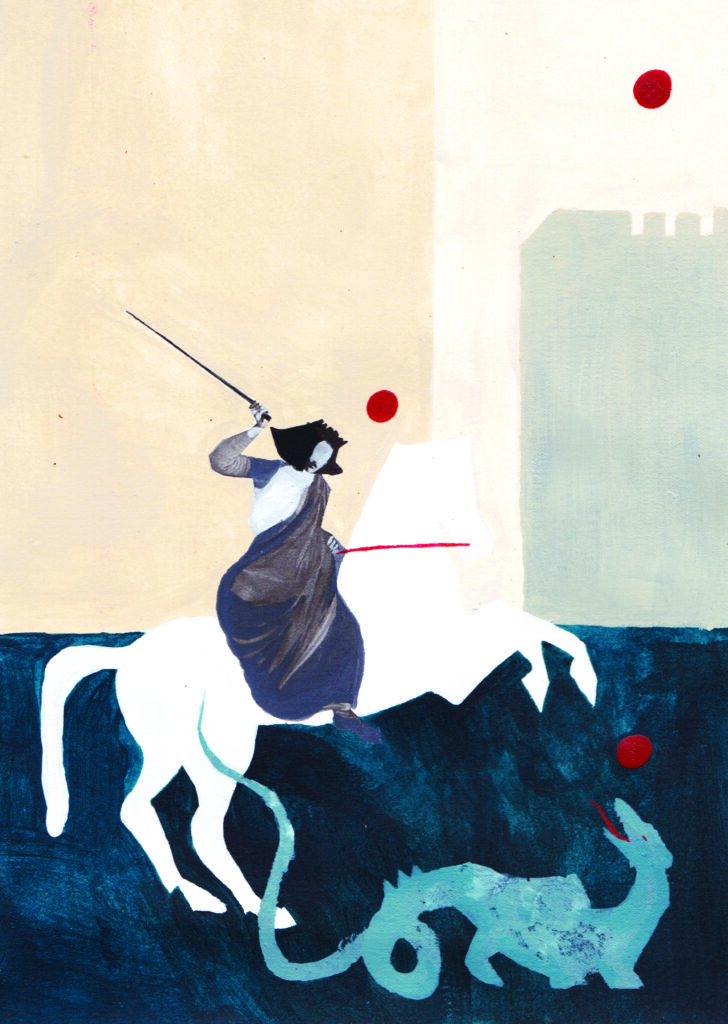
[Lavinia Fagiuoli, San Giorgio non ti serve e il drago, 21×20 cm, mixed media, collage, monotype, acrylics on paper, Venice, 2023, Garance & Marion.]
LF: This was a watershed exhibition. The themes were water, Venetian iconography, and the home. The space makes you reflect on the relationships around you, who you want to be with, who you want to be. June 2024, works from the same period: a piece featuring Milan and Querini. Two personalities in dialogue. There’s the Palazzo del Lavoro in Milan and the Querini Palace.
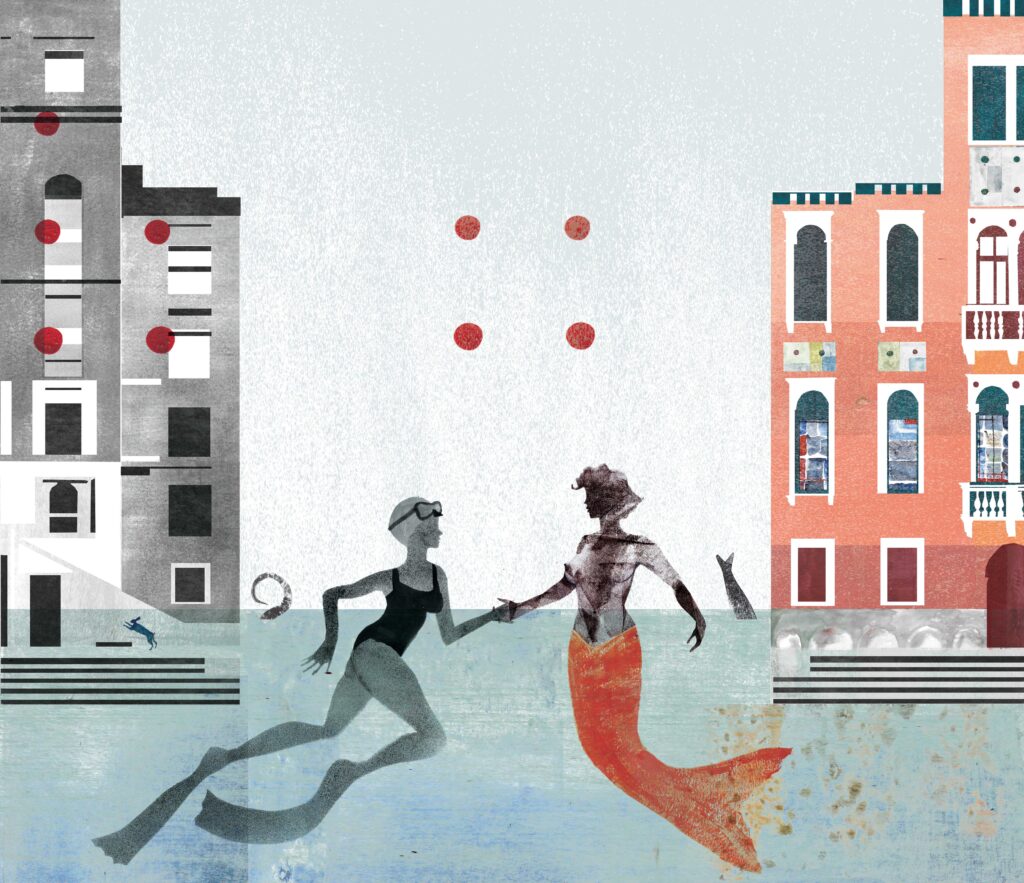
[Lavinia Fagiuoli, Due città, illustration for a mural for the Tabula Rasa Festival, Civitanova Marche, mixed media, 2024.]
– The noon bells ring –
AOS: It’s a bit like your two selves, split between Milan and Venice. You have a law degree. Are you a criminal defense attorney?
LF: No, I’m a civil lawyer. I’ve always worked with children. I graduated with a degree in international law, and my specialty has always been international families – families made up of people from different nationalities and/or families who relocate across countries – and which laws apply in cases of divorce and child custody. Every now and then, I still handle some family law cases. The advantage is dealing with something that belongs to “others,” which distances you from the self-centered nature of art, though, of course, there’s always a bit of yourself in art. Every now and then, focusing on something else, on other people’s lives, takes me away from that self-centered dimension.
AOS: What gave you the push to say, “Now I’m going to make a change and try something different”?
LF: To tell the truth, it was the hard-boiled egg incident. I was working at the studio on projects that interested me – from Milan but also from all over Italy. I was thrilled with my work, but I felt like I wasn’t really living my own life. I started thinking, “What should I do?” It was a journey back to my inner child. I asked myself what I really enjoyed doing. Every now and then, people would ask me to draw and create things, even though I knew absolutely nothing about the world of illustration. So I decided to give it a shot.
AOS: Did you draw a lot as a child?
LF: All the time.
AOS: Have you been able to devote all your time to this while in Venice?
LF: Yes, I devoted almost all my time to drawing. Here are some small illustrations for a book I worked on for Rizzoli, Il pescatore di stelle. They were all painted in Venice. The book is set by the sea, but the drawings are very much inspired by the lagoon. I also drew this palm grove on the island of Certosa. I really enjoy drawing from life.
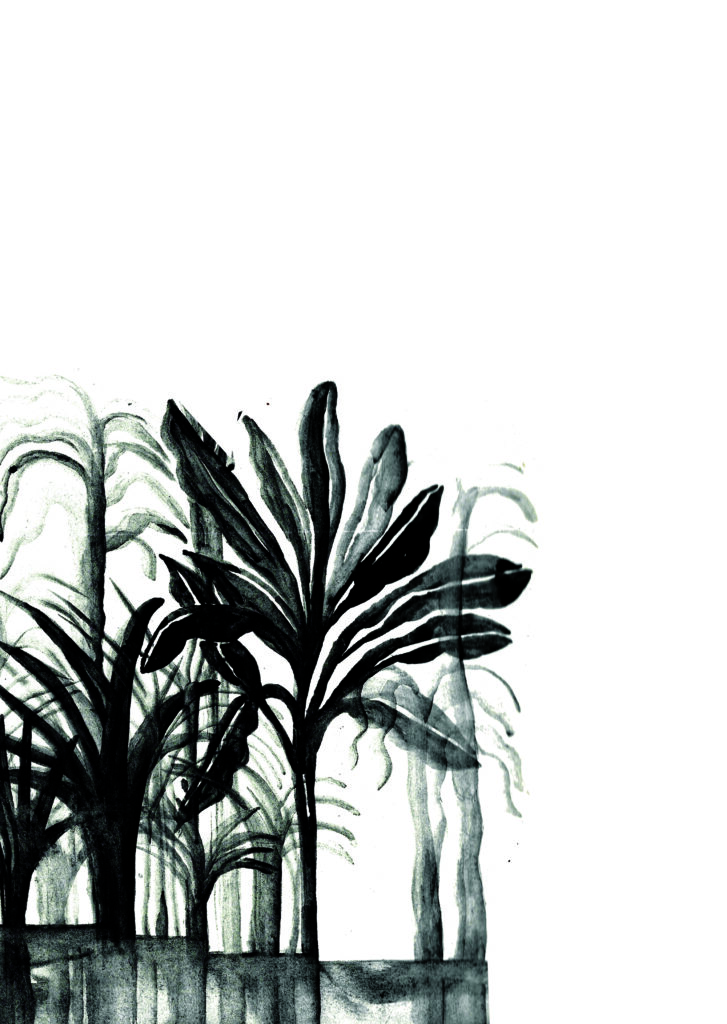
[Lavinia Fagiuoli, Palmeto, ink on paper, 21×30 cm, preparatory drawing for the illustrations for the book Il Pescatore di stelle by Peppe Millanta (Rizzoli, 2025).]
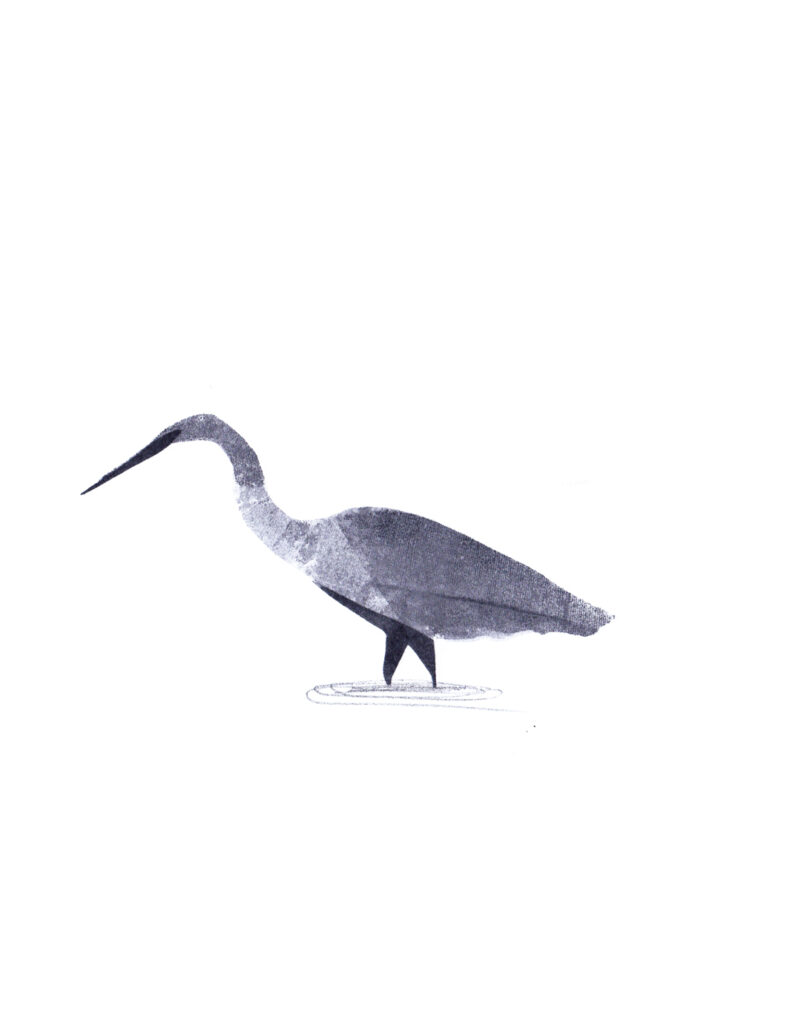
[Lavinia Fagiuoli, Albatros, ink on paper, 21×30 cm, preparatory drawing for the illustrations for the book Il Pescatore di stelle by Peppe Millanta (Rizzoli, 2025).]
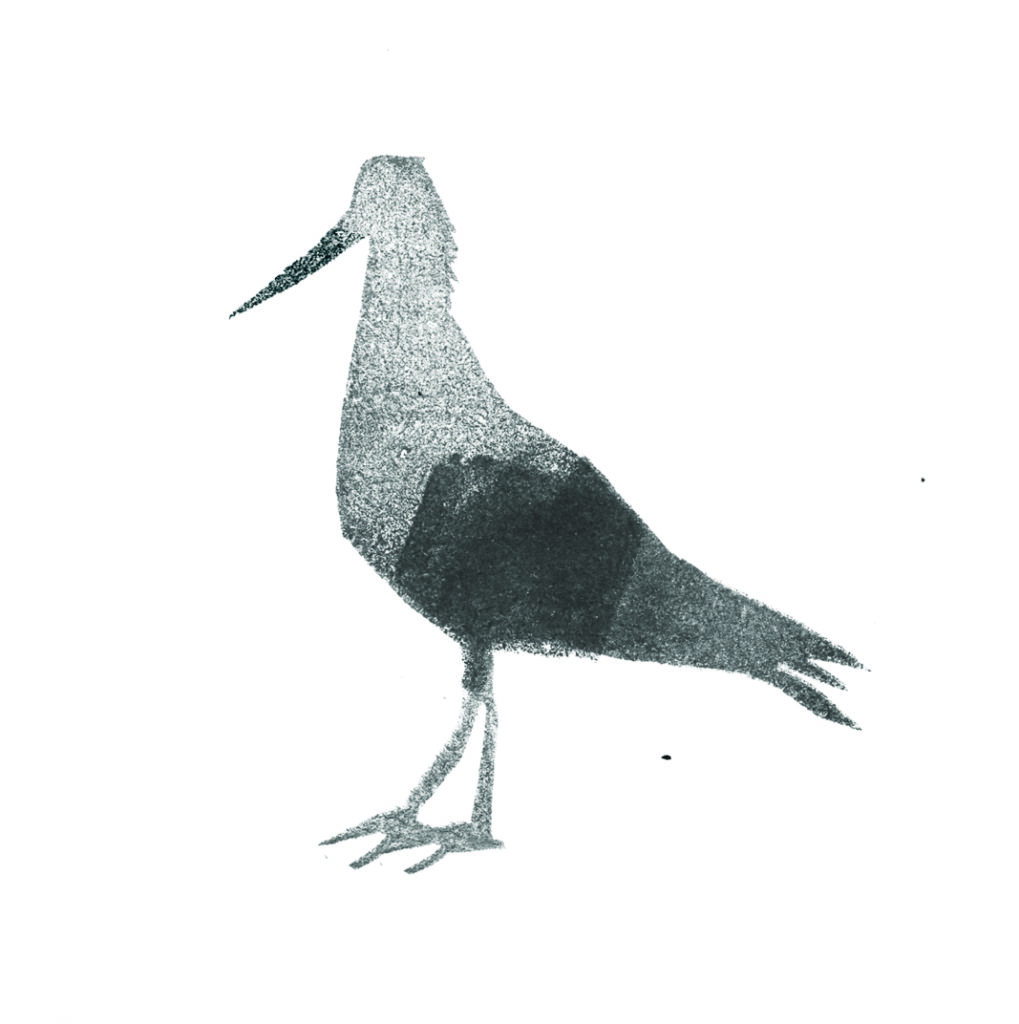
[Lavinia Fagiuoli, Laguna nord, ink on paper, 21×30 cm, preparatory drawing for the illustrations for the book Il Pescatore di stelle by Peppe Millanta (Rizzoli, 2025).]
[Max comes in to take some photos of us]
AOS: Which elements of the lagoon landscape influenced you the most in your drawing?
LF: As I think is the case for everyone, the body of water certainly had an incredible effect on me. But so did the shift in scale, from the extremely narrow to the extremely wide. Walking down a long, narrow alley and then suddenly opening up to the vastness of the sky or the view of the water. This contrast has definitely contributed something to my work.
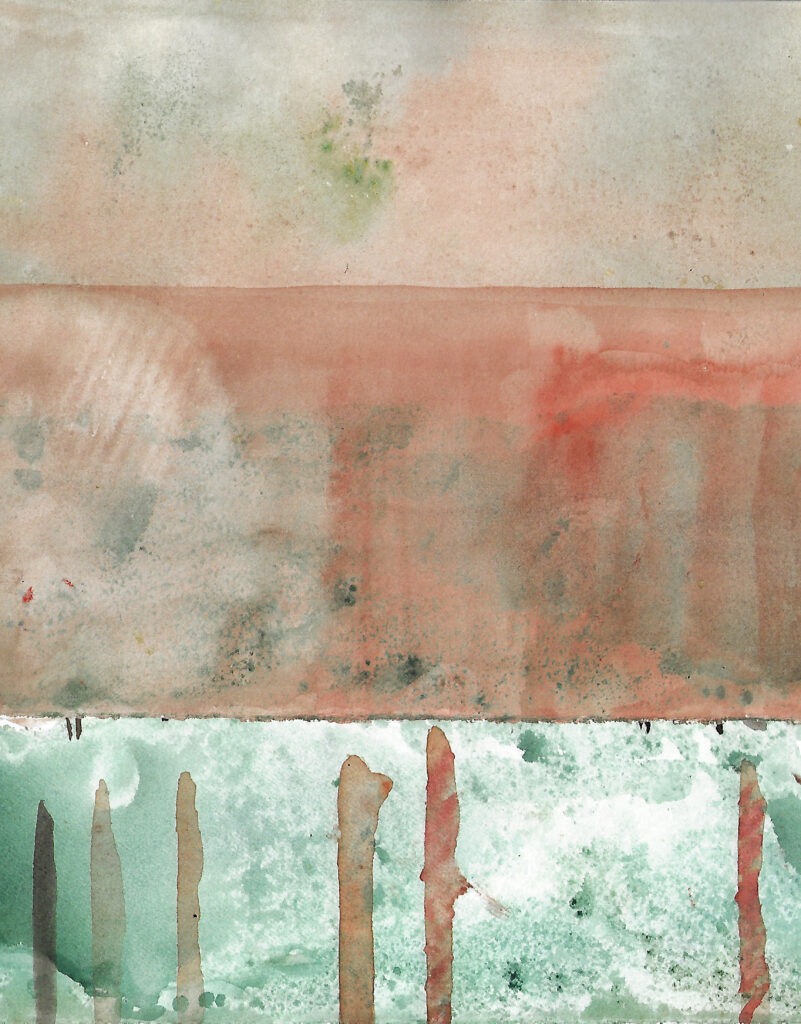
[Lavinia Fagiuoli, Giudecca, watercolour on paper, 40×30 cm, 2024.]
AOS: The American writer Mark Twain alludes to this in his The Innocents Abroad (1869), when he stays in Venice and finds that painters who set out to depict Venice from life are daring, because they are trapped: depicting Venice is impossible; its beauty overwhelms any artistic talent, and ends up making all the paintings look alike.
LF: Yes, it’s extremely difficult to depict Venice. I’ve tried to find my own side door to enter it. As in the exhibition Lettere d’amore, which centered, in fact, on the theme of female friendship.
AOS: In fact, Venice isn’t in the title.
LF: Exactly.
AOS: So you imagine Venice as a woman.
LF: Yes, absolutely. I’m very fond of the iconography of the saints. Starting with the Madonna dell’Orto—near my home; the parish priest knows me by now because I visit her every day—but also Saint Lucy. I feel as though I’m seeing a community of women reflected across the city. One saint who particularly fascinates me is Saint Lucy. I was born in Verona, and children in Verona celebrate Saint Lucy more than they do Santa Claus. But Saint Lucy is a frightening figure: she’s blind and carries her eyes on a platter. When I came to Venice, I was surprised to find her here in her sanctuary, wearing a silver mask, a white cloak, and mummified little feet [her remains are kept in the Church of San Geremia, brought to Venice from Syracuse, where they were originally intended to be]. Venice’s Santa Lucia railway station is so named because it was built next to the church that once housed her remains, which were later transferred to San Geremia. The people of Syracuse have repeatedly asked for her remains back, but the Venetians have never relented; so, to set the record straight, they erected a plaque: “Santa Lucia is here and will remain here forever.” I don’t know what lies beneath the mask. In his book Venezia è un Pesce, Tiziano Scarpa describes how, on December 13th, the Venetians would make a pilgrimage around a statue of Saint Lucy that was not wearing a mask, and he said that Venice is so beautiful that here we can see even the most frightening things.
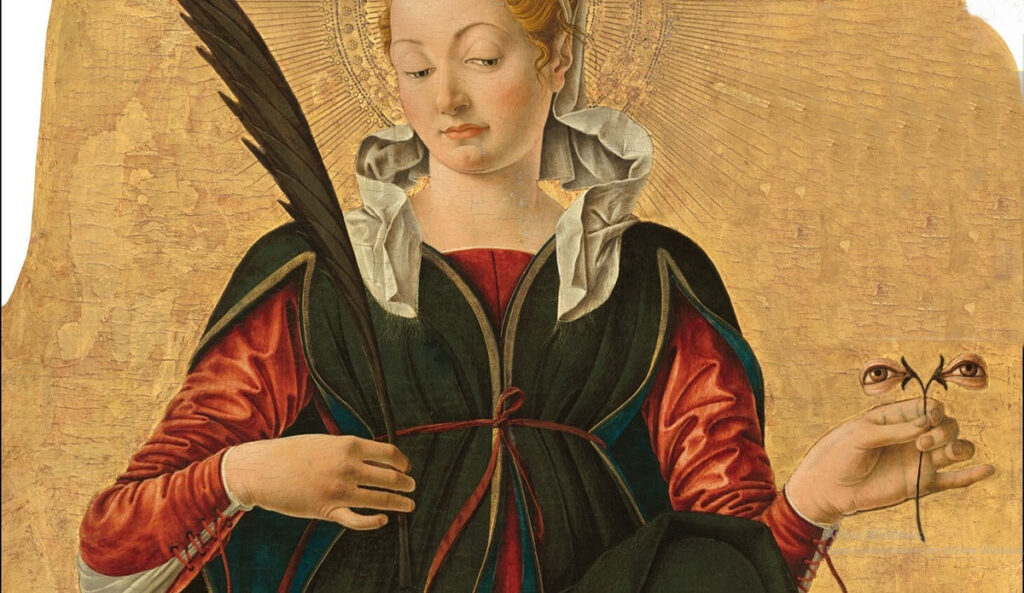
[Francesco del Cossa (1435-1477), Saint Lucy, tempera on panel, 77.2×56 cm, 1473-74, upper right panel of the Griffoni Polyptych, National Gallery of Art in Washington.]
AOS: It’s interesting that you’re associated with a saint who has no eyes.
LF: And who ended up in Venice! Another saint I’ve recently learned about is Saint Margaret, whose statue in Campo Santa Margherita is largely unknown. It’s a very ancient statue, assembled from various reused sculptural pieces. Saint Margaret’s story is similar to that of Saint George and the dragon: she had been held captive, a dragon threatened her, and then –according to one version of the legend – she killed it with her sword. She’s a very feminist saint, and she does everything on her own.
An hour has passed since we started chatting on the wisteria-covered terrace. In that time, we’ve finished our coffee, fresh-squeezed juice, and brioches. Elena’s mom also stopped by with her brother, as did Giada with her mom, who’d come to Venice for her brother’s wedding. Max spent some time on the terrace with us, as did Oriana.In the meantime, it’s lunchtime, and I have to go. I keep thinking about Saint Lucy. I tell her that I found out I was pregnant on December 13th, and I remember a clear, intense light that seemed almost miraculous to me. I even took a photo of the light reflecting off the closed storefronts. That’s how bright that golden day was. I promise Lavinia that we’ll go see Santa Lucia together: back then, in fact, I’d never even set foot inside the church of San Geremia.
Thinking back on Lavinia’s journey, one of my all-time favorite movies comes to mind: Bread and Tulips, by Silvio Soldini. Set in Venice in 2000 – a time that already feels like it belongs to another century – it’s a comedy with an intelligent lightness that continues to make entire movie theaters, packed with Gen Z viewers, laugh. A film that has aged exceptionally well. My psychotherapist recommended it to me over and over until I finally watched it.. The film tells the love story between the sweet Licia Maglietta and a shy Bruno Ganz: two people who, at a certain point in their lives, find themselves discovering love again that is reserved, awkward, and pure, but, above all, a new chance at life. Rosalba, the protagonist, ends up in Venice almost by chance. There, she distances herself from a husband who’s too wrapped up in himself and his routine, and rediscovers her passion for flowers, for the accordion, and, ultimately, for herself. The film’s final scene isn’t about romantic love; in my opinion, it’s really about the love of friendship. A party in the field in front of the house, where all the people Rosalba has met in Venice appear – the very people who led her to stay here, to choose herself, to embrace a gentler life, perhaps a bit saccharine (it is, after all, a romantic comedy) but also more grounded in its simplicity. Fatalità, it really does feel like a summer country festival, just like the ones we’re chasing in the sweltering heat of these days.
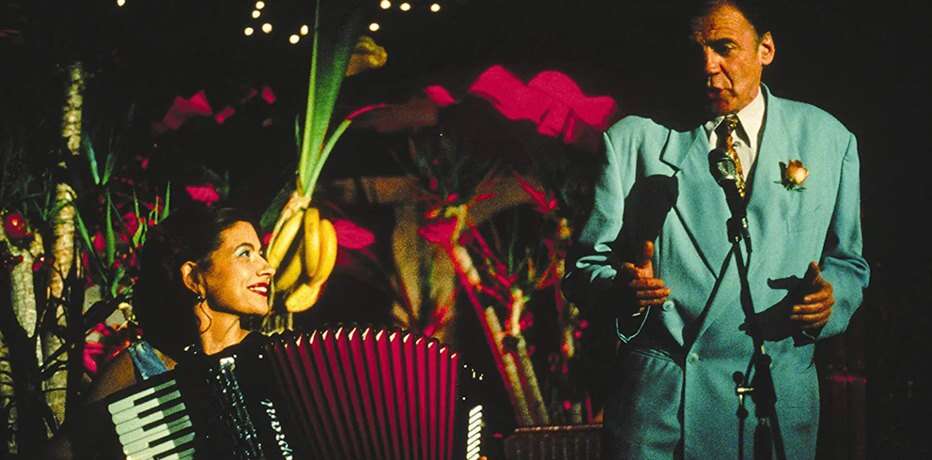
[The final scene from Bread and Tulips (2000), directed by Silvio Soldini.]
*
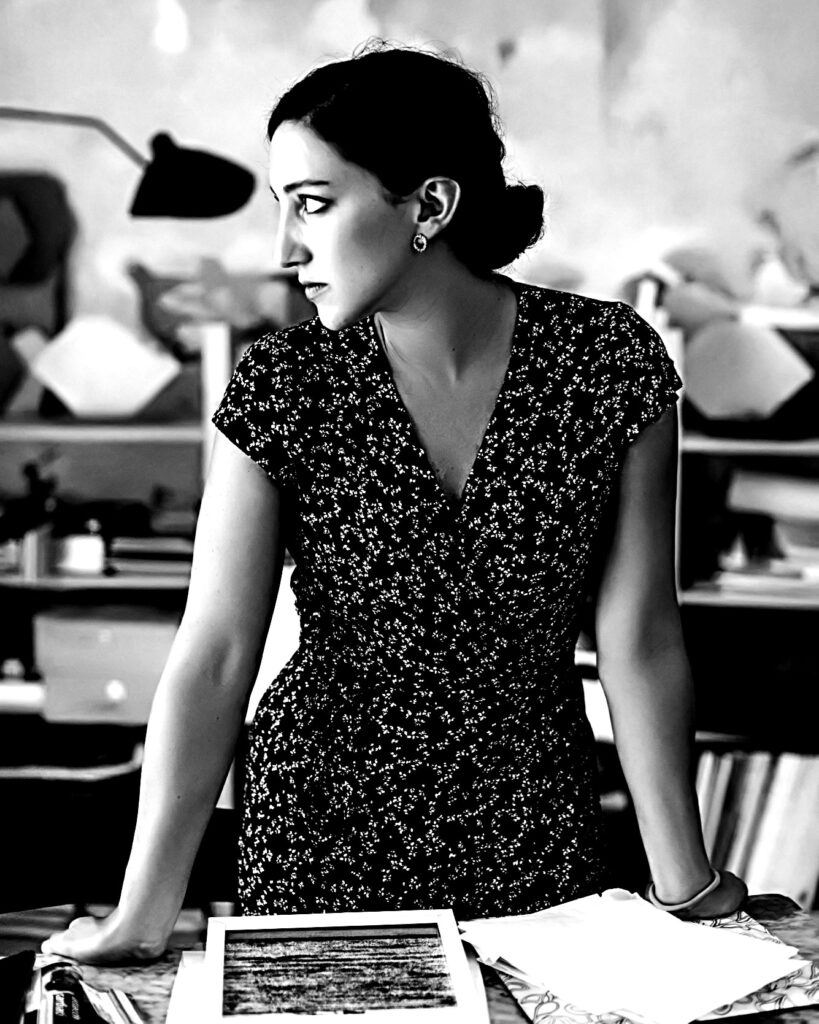
Lavinia Fagiuoli is an illustrator and visual artist working between Milan
— in a beautiful space called Bota Fogo — and Venice, the city that holds her heart.
Her work is grounded in a lifelong relationship with drawing and in traditional techniques including painting, monotype, cyanotype, watercolour, collage and ceramics.
After a career as an international lawyer, Lavinia chose to devote herself fully to visual art. She collaborates with publishers, galleries and cultural institutions, leads workshops and takes part in artist residencies in Italy and abroad. She also works in animated short films. Selected clients and collaborators: L’Espresso, Corriere della Sera (La Lettura, Cook, Sette), Sole24Ore, Domani, Integrale, Review, Iperborea, Rizzoli, Mondadori, Sellerio, Marsilio, Il Saggiatore, Skira Arte, Isola Edipo, Kasa dei Libri, Minotauro, Biagini for Pitti Uomo, Action Aid, Atelier Renata Marseille, El Moderno Gallery Madrid, Garance and Marion Venezia, the World of Dot, XXY studio, Studio Falcinelli, etc.
Alice Ongaro Sartori
Alice Ongaro Sartori is a curator and art historian interested in visual culture and publishing, with a focus on ecology and public space. She is part of Wetlands, a publishing project dedicated to social justice and environmental sustainability.