Beings in between
In June 2025, in the inlet of water between the Museum of European and Mediterranean Civilisations and Fort Saint-Jean in Marseille, I see a group of kids diving in. The signs are explicit: “No swimming,” but they are completely at ease between the dock and the sea, and they keep jumping in and climbing back out, jumping in and climbing back out. Suspended between land and water. They speak a fast, tight French. I understand almost nothing of what they say to each other as they clench their teeth from the thrill of diving and the cold. They are playing. Some have olive-toned skin, others are sunburnt. They dive with their arms folded, feet first, but also headfirst, opening their arms wide. As I watch them shout and laugh for nearly two hours, I can think of only one thing: gulls.
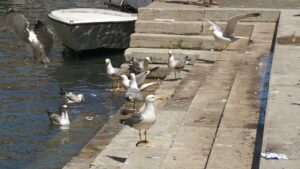
Yellow-legged gulls (Larus michahellis), with their yellow legs and a few white markings on their tails — different from the common gulls depicted in Hugo Pratt’s comics — have long crossed the Venetian lagoon, but they have only been living in the city of Venice for just over two decades. The story of yellow-legged gulls is one of an interrupted migration. They are among the species that concern the administrations of many Italian and European cities — such as Marseille, Porto, Naples, Rome, and Trieste — when it comes to managing urban wildlife. The city, as an inhabited space, has become inviting: there is always food available, a stable and ideal temperature, plenty of empty buildings for nesting, a rising sea level. Around the year 2000, ‘magoghe’ (the Venetian dialect term used to refer to yellow-legged gulls) are first seen nesting on the rooftops of the island of Venice. People are not used to seeing them year-round and, above all, are not used to seeing them in the city.
The sea, sandy coasts, salt marshes, and small predator-free islets have traditionally been the natural habitats of these animals, which need to perform a specific reproductive choreography in order to brood, positioning themselves at a certain distance from one another.
Danilo Mainardi, a Venetian ethologist and researcher who passed away in 2017, and Cecilia Soldatini, an expert in bird ecology and marine ecosystems, carried out the first studies on the colony of yellow-legged gulls that had recently settled in the historic center and in some emerged lagoon areas south of the Ponte della Libertà (Mainardi & Soldatini, 2006).
Then, for almost ten years, the study and monitoring of the yellow-legged gull population — which continued to grow — was carried on by Francesca Coccon, an ornithologist, naturalist, and CORILA consortium researcher, based at the former building of Magistrato alle Acque. The research project also involved VERITAS — a venetian society responsible for waste management among other public services —, as gulls in the city had begun to peck at waste, tearing open garbage bags and undermining urban cleanliness and aesthetics. The gulls.
Francesca and I met in March 2024, when I began my thesis research to explore the interactions between humans and yellow legged gulls in the city of Venice. Over the course of twenty years, a series of conflictual and/or cooperative relationships had emerged between the species, which struck and fascinated me. Humans and gulls: I wanted to observe them more closely, to discuss the entanglements that tie them to the lagoon’s socio-ecological context, to understand when they hate each other and when they love each other. From the very beginning, I wondered how I could practice anthropology with both human and non-human neighbors, and how I might shift the way of seeing things that I had always relied on.
In ‘Ethnic Identity’ (1992), Ugo Fabietti writes that adopting an anthropological perspective means practicing a “suspension of judgment,” questioning those ideas that, by the “force of tradition,” we are used to taking for granted; habits of language and representation, Fabietti argues, that have kept us bound. Isabelle Stengers speaks of “slowing down reasoning” (2005) when we attempt to understand conflicts, differences, and assonances among beings. Slowing down makes it possible to give time for further reflections to emerge, rather than rushing toward quick resolutions that take for granted that things are simply the way they are and must be that way.
Doing anthropology means slowing down and asking how and why something exists and acts in the present, with the awareness that, more often than not, there is no single answer. So I slowed down. I spoke with many people, watched wild gulls become domesticated, and questioned the political line that separates nature from the city.
I wondered why the yellow-legged gull is considered a native species, yet at the same time parasitic, sometimes even labeled as invasive — a term usually used for non-native species that are introduced (or introduce themselves) from one “original” habitat to another, causing ecological imbalances and biological change. And who is the yellow-legged gull for the human who sees it, hears its squawk, attacks it, injures it, and insults it in Venice?
The yellow-legged gull has not always been, rather, it has become a “threatening,” “problematic” species.
Yellow-legged gulls are resident in the city. They walk more than they fly.
A fisherman friend once called them ‘the pigs of the lagoon’, making me realize how a true reconfiguration of the movement possibilities and choices of urban yellow-legged gulls had taken place. In anthropology, the term ‘affordanc’e refers to a subject’s capacity to recognize and interpret the things of the world as accessible to their own needs (Gibson, 1977 in Keane, 2014; Ingold, 2022; Benussi, 2022). This affordative capacity is not unidirectional, with a subject acting upon a passive object, but rather relational and potential, depending on the combined characteristics of bodies.
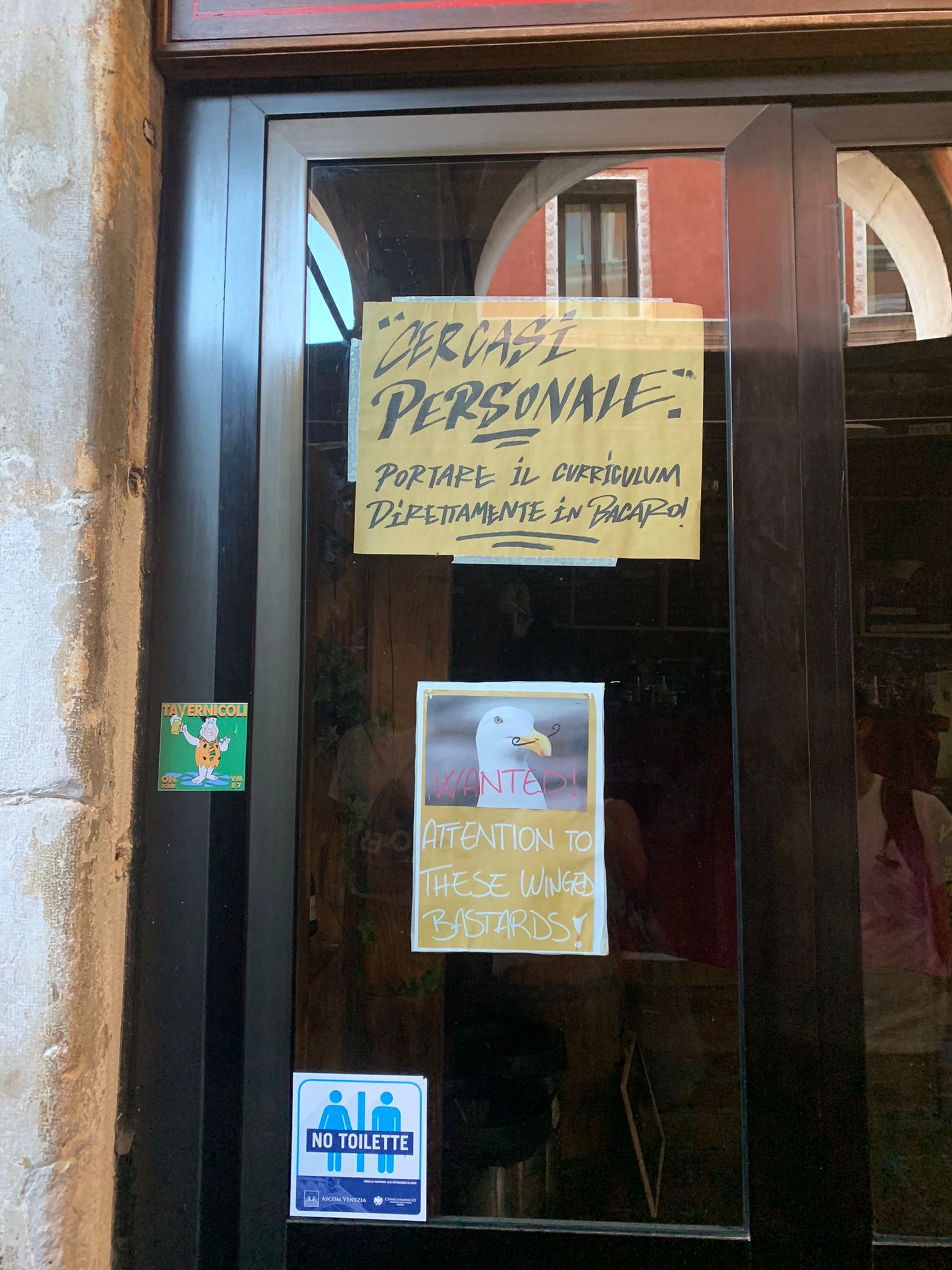
As the conditions that make the sea and the Venetian lagoon accessible to the yellow-legged gulls have changed, the city has become a habitat, supporting the species’ settlement, reproduction, and feeding. This environmental reconfiguration places yellow-legged gulls in a hybrid ontological position, such that it is no longer possible to say whether they are a domestic or a wild species. I like to call them beings in between. They are in between because they inhabit “in-between ecologies” (Whitehouse, 2015), spaces of intersection between the city, the lagoon, and the sea. Moreover, they are a protected species, yet — like other urban species such as pigeons or rats — they become “too many,” occupying what has been described as an “ontological condition of exterminability” (Timeto, 2020). “In between” because they are inconvenient: they clash with the maintenance of urban decorum and cleanliness of public spaces, and they prevent both tourists and residents from walking peacefully, having learned to snatch food from people’s hands. They are a damage for restaurant owners and fishmongers.
At the Ca’ Roman Oasis, they have even been attributed a questionable morality for eating the eggs of the Kentish plover, an endangered species.
“In between” also in the opinions of residents: between those who welcome them into their homes, defend them, and feed them from their windows, and those who despise and attack them. The gull is a fragile animal. “It’s as light as a feather,” Teresa once told me, after she cared for a few months for a gull chick she had found on the ground. It takes very little to break their bones. “It would take so little to save them when they are run over in the streets” Antonio explained to me, who keeps five injured gulls in his garden, unable to fly.
The heavy rains of June 2024 and the effects of building renovations under the “Superbonus 110” scheme have hindered the reproduction of many pairs, to the point that their population is now stable — or even declining (Coccon, 2024).
In this present time, and in cities, yellow-legged gulls have become a companion species, as Donna Haraway (2013) would put it, subject like human beings to social, environmental, political, economic, and health-related changes and fractures.
The yellow-legged gull is alive and acts in relation to humans and the city’s infrastructures. It is also a earthly being (Haraway, 2019), which, in living, is composed through experiences and actions entangled with the experiences and actions of human beings.
I continue to question the complexity and the risks involved in the increasing proximity of wild species. And I wonder who can still be defined as wild when humans occupy the spaces of other species. How and when are we responsible for the lives and deaths of the animals we consider distant?
As I write, I am brought back to the cool, humid wind of June and to that group of strong, unruly kids who do not follow the rules in a fast and crowded city. A group of uncontrollable, uncontainable children calling out to one another and chasing each other through the streets.
And then, just as quickly, the smell of fish and salt, the time spent at the Rialto market and in Venice’s most frequented ‘campi’, where I witness the continuous and frenetic exchange of glances between humans and gulls as they compete for food and try to avoid having it stolen.
Gulls, humans. Humans, gulls.
Eleonora Puliero
Eleonora Puliero holds a MA degree in Cultural Anthropology, Ethnology, and Ethnolinguistics, with a thesis focusing on multispecies urban ecology and the processes of wildlife urbanization. Since 2024 she has collaborated with Metagoon and Ardór as a researcher and writer. Through the analysis of inter(el)ations between humans, non-humans, and environments, she explores the dynamics and processes that entangle species.